

The night before, she sat at the kitchen table past midnight with a skin formed on the coffee an hour ago. The speech was beside her on the white Formica. Next to the speech was a list of men. . The window stood open; her blouse stuck between her shoulder blades, and out on the street the lamps burned in the June haze. A cab rolled past trailing dance-band music from its radio.
The list was the men who’d said no — the sixteen who agreed with every word and still would not sign, the ones who said the timing was wrong. “Wait for the Tydings report,” they said in their office with the door shut holding the pages by the edges like a verdict, and handed the pages back. “Joe will come for you,” they said, not meeting her eyes. These were Senior men, men with safe seats and twenty years in the United States Congress, men who had stood in the chamber the day she was sworn in as the first woman of Congress. They pulled out her chair for her and winked to one another.
The phone sat on a black table in the hall and had not rung since eight. She looked at the speech without reading it. She turned the cold cup once on its saucer. The refrigerator kicked on. She sat with her hand flat on the pages and then she washed the cup and dried it and stood it in the rack — one cup, one spoon — and went to bed. She lay there with her eyes open and listened to bottles clinking in their crate on a tailgate somewhere east of her. This meant the milk trucks were running, which meant it was already morning.
A rose came up from the florist on Connecticut Avenue, like it did every morning by eight, boxed, one stem, and when she lifted the lid the box breathed out its smell of cut stems and refrigerated water. Red today. She pressed the pin through her lapel and through the stem and bent the point back with her thumb the way she had done it for ten years, and in the outer office Bill Lewis’s typewriter stopped.
“Final copy,” he said from the doorway. He held the pages as if they were wet.
“Read me the third paragraph.”
She watched the street while he read — Delaware Avenue, a mail truck, two Capitol policemen talking with their hats off in the shade. The paragraph was right. It had been right last night at her kitchen table and it was right now and listening to it she felt the same thing she had felt last night which was not what she had expected to feel. She had expected to feel the size of it. What she felt was that it was finished after waiting too long.
“Carbons for the press gallery,” she said. “Run them after I’m on my feet. Not before.”
“Tobey’s office called. He wants to know if there’s anything he should do.”
“There’s nothing for any of them to do. Their names are on it. That’s the whole of what I asked.”
Lewis squared the pages. He was a colonel in the reserve and he squared things. “Six are with you,” he said. “I went over the list again last night, thinking who else. Aiken, Tobey, Morse, Ives, Thye, Hendrickson. I couldn’t come up with a seventh.”
“Neither could I,” she said. “Put the statement in the folder with the rest.”
In the folder was the transcripts of the Tydings hearings, the committee records, the photostats — the actual photostats, the ones Joe McCarthy waved at the cameras like a man waving a fish he wouldn’t unwrap. She had asked to see them. She had sat with them after the floor closed, with her glasses on and a legal pad, and gone name by name of the accused, and cross-checked the names against the loyalty files where the files existed, and there was no evidence. Not a thin case. Nothing. This man, Joe, who put his pants on like everyone else had stood up in Wheeling, West Virginia, with a list of traitors, and the people changed by the week. The country had been running a fever ever since over a piece of paper nobody had read because there was nothing on it to read.
She put on her hat. Lewis held the door.
“Senator,” he said, and stopped, and she waited, and he didn’t finish it, so she went out past him to the elevators with the folder under her arm and a roe in her lapel.
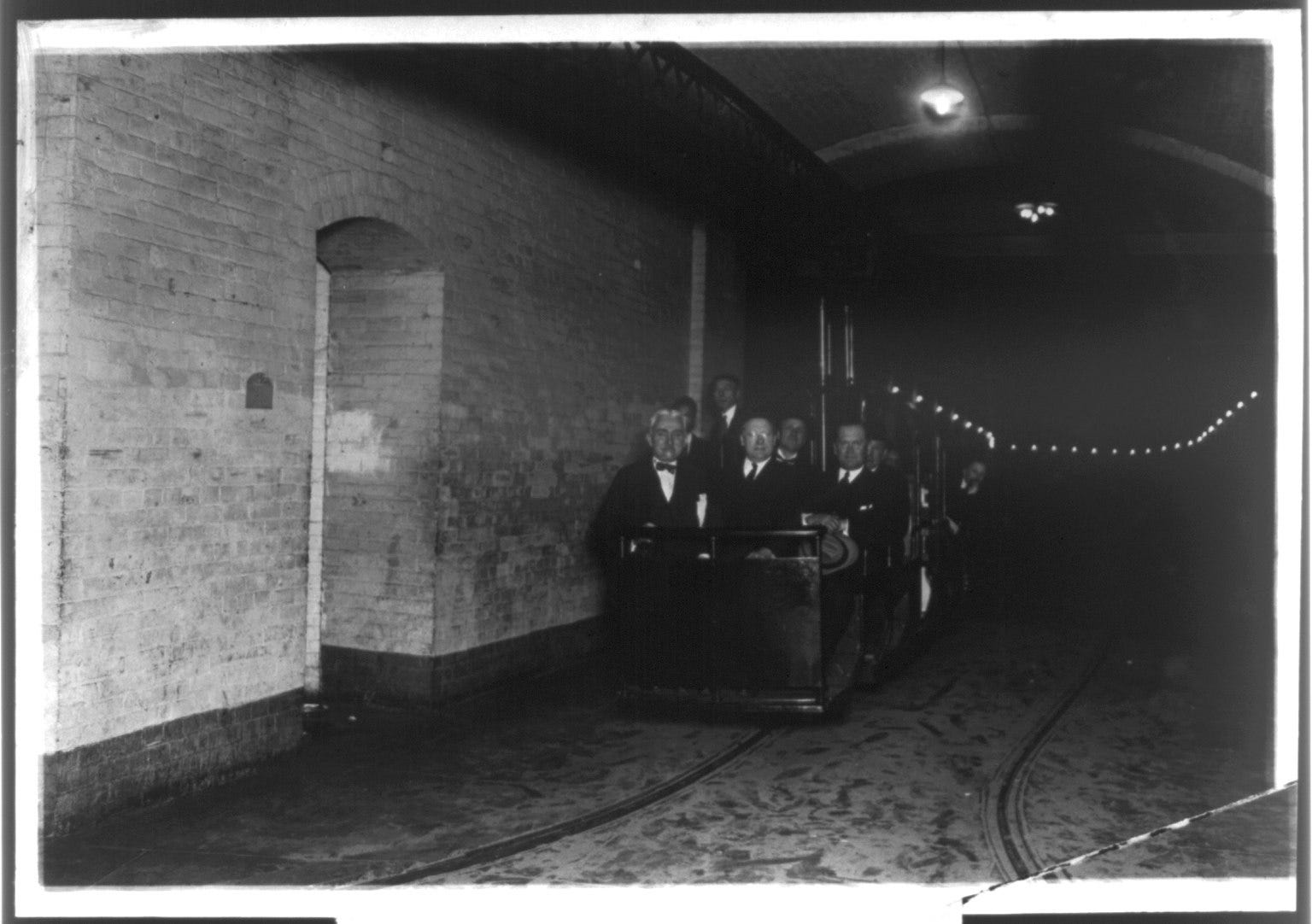
The subway ran in the tunnel under the lawn between her office and the Capitol, an open car on a single rail, pushing air at her which felt cool and smelled of wet concrete and electricity. The operator called every senator by name and never got one wrong. Her’s was easy, the only woman, the first woman.
He nodded at her. “Senator Smith.”
“Good morning, Albert. How did Doris’s recital come off?”
“She forgot the middle part and played the end twice.” He took the brake off. “Her mother cried anyway.”
“Mothers do. Tell her the end was the part worth hearing twice.”
He laughed, and the car rolled, and she had it to herself until Joe joined her.
McCarthy came down the steps two at a time, big through the shoulders, jacket open, a man who moved like he was being filmed. He saw her and grinned and swung onto the bench across from her. He brought cigarettes and bay rum onto the car with him and under those the smell of a man who had sweated late into his shirt winning at something.
“Margaret.” Up the tunnel the lights came on one at a time ahead of the car and went out behind it. “You look very serious this morning. Don’t tell me you’re going to make a speech.”
“Yes,” she said. “And you will not like it.”
The grin stayed where it was. “Is it about me?”
“I’m not going to mention your name.”
He laughed at that, one syllable, and looked away up the tunnel, and for a moment the only sound was the rail ringing under them. Up close the skin under his eyes hung blue with no sleep and stubble climbed one jaw higher than the other where the razor had hurried. She noticed his socks didn’t match — one brown, one black — and she went down him item by item, collar to shoes, the way you go down an inventory of a thing you are about to be done with.
“Remember, Margaret,” he said. The voice was friendly. The voice was always friendly. “I control Wisconsin’s twenty-seven convention votes.”
The car ran into the light at the Capitol end. She stood and gathered the folder before it stopped.
“For what it’s worth, Joe,” she said, “I’m not running for anything this morning.”
She went up the steps and didn’t look to see whether he followed.
The chamber on the first of June was an ordinary chamber. That was the thing nobody believed afterward — that it was a typicl calendar morning, a dozen senators at their desks slitting mail, the galleries holding tourists in summer clothes who had come to see the room and would settle for anybody talking in it. The light stood down from the high windows and struck through the dust above the desks. A page went desk to desk with the calendars and the air smelled of floor wax and cigars the way it had smelled since before she came and would long after she left.
The presiding officer recognized the senator from Maine.
She stood at her desk in the back row, center aisle, and put on her glasses and laid the pages flat. She did not look at the galleries and did not look behind her, where Joe had come in and taken a seat two rows back. She had heard him come in. He sat directly in her hearing and said nothing. She gave the silence behind her no more attention than the dust.
She said she would speak briefly and simply about a serious national condition. She said the United States Senate had long enjoyed worldwide respect as the greatest deliberative body in the world, and that recently that reputation had been debased — and she went on in that register, plain, declarative, a sentence and then the next sentence, the way you read a list of weights and measures. She spoke as a woman. She spoke as a United States senator. She spoke as an American. She named the things she took to be the basic principles of the country — the right to criticize, the right to hold unpopular beliefs, the right to protest, the right of independent thought — and she said those rights were being taken from people by exposure and smear, without evidence, and that the party doing it was her own, and that a party that rode to victory on fear and ignorance and bigotry and smear would buy a victory not worth having.
She accused no one. When she finished she read the statement, with the six names on it, into the record, and took off her glasses, and sat down.
There was no demonstration. The Senate does not applaud. The presiding officer moved to the next order of business in the voice the Senate keeps for every business, and the calendars went on around the room, and behind her she heard Joe get up — the chair again, the weight coming off it — and walk up the aisle and out through the swinging doors without a word to anyone. Tobey came over and shook her hand and his eyes were wet, which embarrassed them both. Lewis was already in the press gallery with the carbons.
She gathered the folder. The whole of it had taken less time than the morning’s prayer and the reading of the journal.
What it cost came in installments, which is how the Senate bills you.
In the cloakroom that summer she became Moscow Maggie. Never to her face. The name traveled the way names do there, by men grinning at other men over coffee under the low lamps, smoke pooling against the ceiling, and the leather door sighed open and she came through it and the grinning stopped, and the door swung shut behind her and it started. He told reporters the seven of them were Snow White and the Six Dwarfs, and got his laugh, and the laugh ran in the papers next to her photograph.
Three years on, the voters of the country having spoken in their wisdom, he had the chairmanship and the investigations subcommittee that went with it, and the first use he made of the gavel was to take her seat on it away. She read about it in the paper like everyone else, at her own kitchen table, the same table, and creased the page along the column with her thumbnail and cut it out with the kitchen shears. She kept the clipping.
In ‘fifty-four he reached into Maine itself. The boy’s name was Jones — a staffer of his, a Maine boy by birth certificate anyway — and the money came in from away, and the boy went up and down the state saying she had been soft on the Communists, in mill towns where she knew the foremen by name and the foremen’s mothers, in Grange halls where the coffee urns ticked along the back wall and the bean pots had been in the ground since morning and the floorboards gave off forty years of oil, halls where she had eaten more bean suppers than the boy had years. She flew home weekends and answered no charges and missed no roll calls. In June the state gave its answer: five of hers for every one of his. She sent the boy a courteous note.
In December of that year the Senate took up at last the matter of its own debasement, four years late, in its own language and at its own pace, and when the clerk reached her name on the censure roll she said the one word from her desk and went back to her mail.
The schoolchildren came to Skowhegan on a yellow bus in October, thirty of them, eighth grade, up from Augusta. By then the library stood on the bluff beside the house, her papers in it, and she received the classes herself when her health allowed, in a wool suit, the rose on the lapel, ninety-one years old and straight as the doorframe she stood in to count them coming up the walk. Frost still grayed the grass on the shade side of the walk, and the children came up through it loud, breath showing, and went quiet at the door the way children do at thresholds.
In the gallery the speech lay open under glass — the reading copy, her pencil marks still on it — and the children filed past it the way children file past anything under glass, and one girl stayed behind when the others moved on. She read the whole first page with her finger above the case, not touching. Then she looked up.
“Were you scared?”
The teacher started forward. Smith lifted two fingers off her cane and the teacher stopped.
“I’d read the record,” she said. “All of it. There was no evidence in it. Somebody who’d read it had to stand up and say so, and I’d read it.” She looked down through the glass at her own pencil marks, the little carets, a word struck out and the same word written back in above the line. “Fear was the whole of what he had. It seemed to me a poor reason to add mine.”
The girl considered that and nodded the way the young nod, banking it for later, and ran to catch the others. Out the long window the bus stood yellow against the bare trees, and below the bluff the Kennebec went by, gray and pushing, the way it went by all day whether anyone stood at the window or not. Smith stayed at the case a moment with both hands on the cane. The light through the glass lay flat on the old pages. The pencil had faded more than the type. Her marks were still legible, all of them, and she read down the margin to the bottom of the page, and then the bell at the door went, another class coming up the walk, and she straightened the rose with one thumb and turned to count them in.
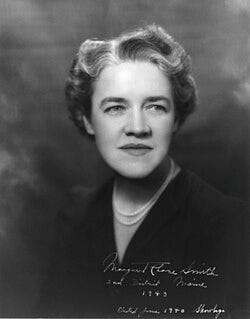
Margaret Chase Smith — United States Senate, 1950
Margaret Chase Smith (1897–1995) of Skowhegan, Maine, entered the House in 1940 to finish her late husband’s term and won the Senate in 1948 — the first woman elected to both chambers. On June 1, 1950, four months after Senator Joseph McCarthy of Wisconsin claimed to hold a list of Communists in the State Department, Smith delivered her “Declaration of Conscience,” the first challenge to McCarthy from inside his own party. Six Republicans co-signed. McCarthy never produced his list. He retaliated for four years, until the Senate censured him in December 1954, Smith voting aye. She served until 1973; in 1964 she became the first woman placed in nomination for president by a major party.